Portable power concept
Battery power from waste heat.
A box about the size of a small ice chest that burns waste and uses a Stirling engine to generate electricity for charging a battery.
The output goal: the same general range as a portable solar panel.
Explore the simulation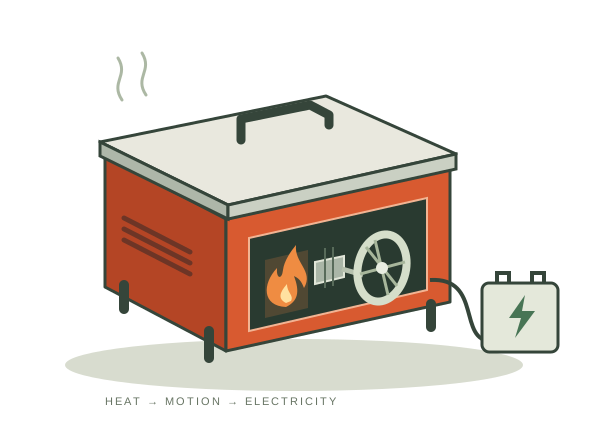
The energy path
From heat to a charged battery.
- 01
Burnable waste
Combustion provides an external source of heat.
- 02
Stirling engine
A temperature difference drives the engine’s motion.
- 03
Generator
Mechanical motion is converted into electricity.
- 04
Battery charging
Power electronics deliver energy to the battery.
Explore the numbers
What could a pwrbox produce?
Change the assumptions in this first-order energy balance. The results are estimates, not measurements from a built device.
Electrical power into the charger
84W
- Power stored in the battery
- 79 W
- Heat the engine’s cold side must reject
- 1,034 W
- Fuel energy stored as electricity
- 2.1%
Model assumptions and limits
Defaults: 16 MJ/kg dry-feed heating value, 90% combustion efficiency, 60°C engine cold side, 20°C ambient, 85% generator efficiency, 92% power electronics efficiency, 8 W auxiliary demand, and 94% battery storage efficiency. Moisture carries an assumed 2.6 MJ/kg evaporation load. Battery charging is capped at 150 W.
The model assumes the selected temperatures and heat capture can be maintained. It does not resolve engine geometry, gas pressure, combustion chemistry, emissions, warm-up, or charge taper. Cooling load is a required design input, not a demonstrated cooling solution.
The engine conversion model is a chosen fraction of the Carnot limit. See YANMAR’s explanation of Stirling engine operation and thermal efficiency. The pwrbox assumptions are independent of YANMAR’s products.
Download the baseline model resultsThe engineering repository
A design that can be simulated and manufactured.
The repository is intended to hold the full details needed to make the parts, assemble pwrbox, and reproduce its simulations.
Manufacturing records
Parametric CAD, part drawings, materials, tolerances, a bill of materials, assembly instructions, and inspection criteria are the intended manufacturing package.
Reproducible simulation
The browser and command-line tools share one energy model. Scenario runs track fuel input, engine conversion, electrical output, battery energy, and cooling demand.
Current stage
The energy model and an illustrative enclosure envelope are available. Detailed engine design and fabrication drawings remain open engineering work. No parts are released for manufacture.